Purchasing footwear online involves navigating multiple regional measurement scales. A men's size 9 in the United States does not match a size 9 in the United Kingdom, and neither converts directly to a European 42 without knowing the underlying cobbling standards.
Mismatched sizing scales cause frequent online shoe exchanges and returns. AllShoeSizeConverter calculates equivalent footwear measurements across major national standards, allowing shoppers to verify sizes against physical foot length in centimeters.
How to use the converter
The interactive converter translates measurements through three steps:
- Select your category: Men, Women, or Kids. Sizing scales and baseline zero points differ between these demographic groups.
- Select your known size system: US, UK, EU, India, Japan, or physical length in centimeters.
- Read the converted values across the remaining regional standards.
For verification against physical shoe construction, refer to our barefoot measurement protocol before placing an international order.
Engineering behind global sizing systems
Shoe sizing developed through regional trade practices rather than an agreed international standard:
- United States (Brannock standard): Codified by Charles Brannock in 1927, US sizing uses the 1/3-inch (8.46 mm) barleycorn increment. Men's and women's scales begin from different baseline lengths.
- United Kingdom: British sizing also uses the 1/3-inch barleycorn increment. Under ISO/TS 19407, UK men's sizes run 0.5 size below US men's (US 9 = UK 8.5), while UK women's sizes run 2 sizes below US women's (US 8 = UK 6).
- European Union: Continental Europe constructs lasts according to the Paris Point, established in France as 2/3 of a centimeter (6.67 mm). EU sizes are unisex: EU 41 indicates a 26.5 cm foot length for both men and women.
- Japan and Mondopoint: Codified in JIS S 5037 and ISO 9407, Japanese and alpine footwear sizing represents actual foot length in centimeters and millimeters with zero gender offset.
- India: Indian footwear manufacturing standard IS 1638:1969 adopted the British barleycorn system directly, making Indian sizes equal to UK sizes in footbed length.
Men to women shoe size conversion and width dynamics
In American footwear, converting between men's and women's models follows a 1.5-size numerical difference:
- To convert from men's to women's sizes, add 1.5 sizes (US Men's 8.5 equals US Women's 10).
- To convert from women's to men's sizes, subtract 1.5 sizes (US Women's 8.5 equals US Men's 7).
Width profiles differ between categories. Standard men's shoes use a D width last, while standard women's shoes use a B width last. A woman buying a men's sneaker gains roughly 4 mm of ball girth across the forefoot, whereas a man buying a women's model receives a narrower shoe.
Children's footwear numbering
Children's footwear sizing in North America divides into two consecutive numbering ranges:
- Child and infant sizes run from 0C (approx. 8.3 cm) through 13.5C (approx. 19.7 cm).
- Youth sizes restart at 1Y (approx. 20.0 cm) and extend through 7Y (approx. 25.0 cm).
- At size 7Y, a youth footbed matches an adult Men's 7 or adult Women's 8.5 in length.
Children's apparel tags such as 2T or 3T indicate clothing heights and do not correspond to shoe sizes. A child wearing 2T clothing typically requires a shoe between size 5C and 7C.
Brand last variations
Manufacturers adjust their lasts according to sport, construction, and regional customer profiles:
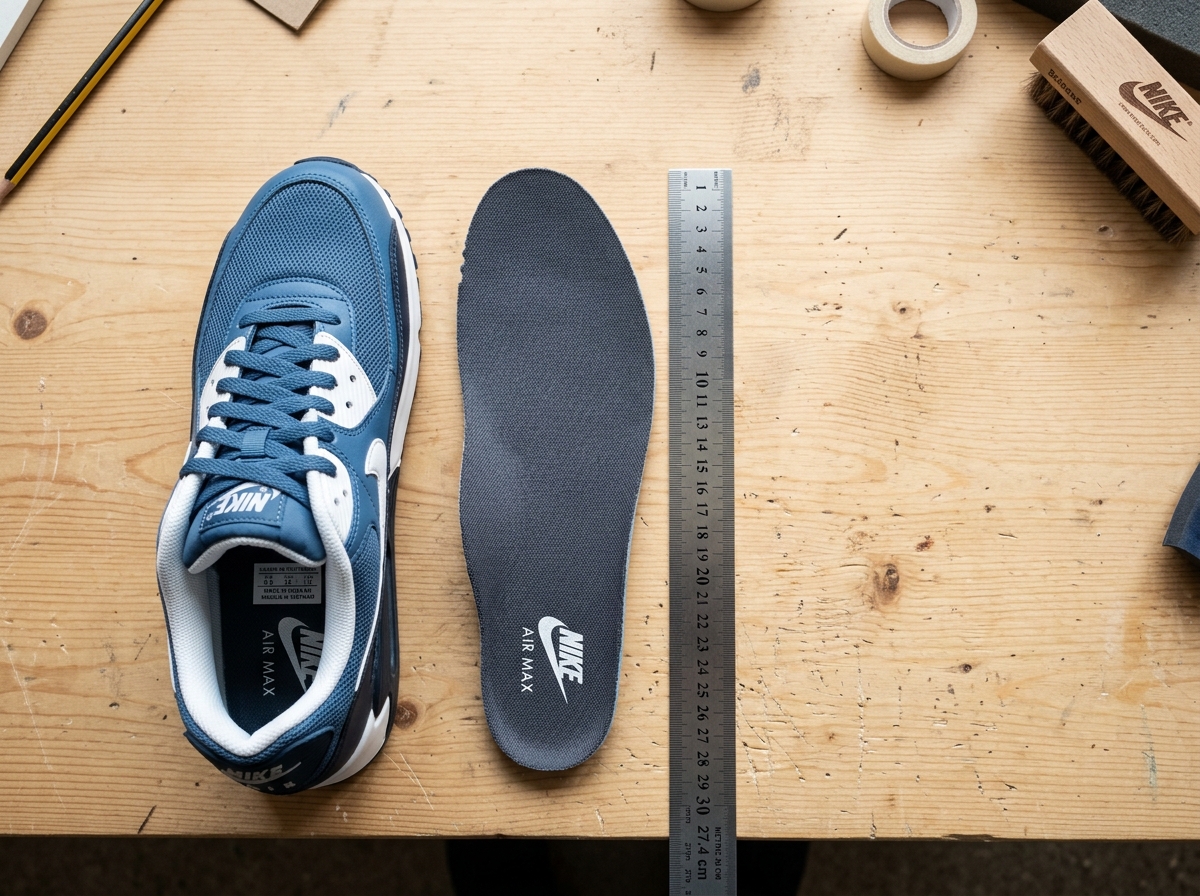
- Nike athletic sneakers often run snug through the midfoot arch, and their men's conversion uses a 1-size offset from UK (US 10 = UK 9 = EU 44).
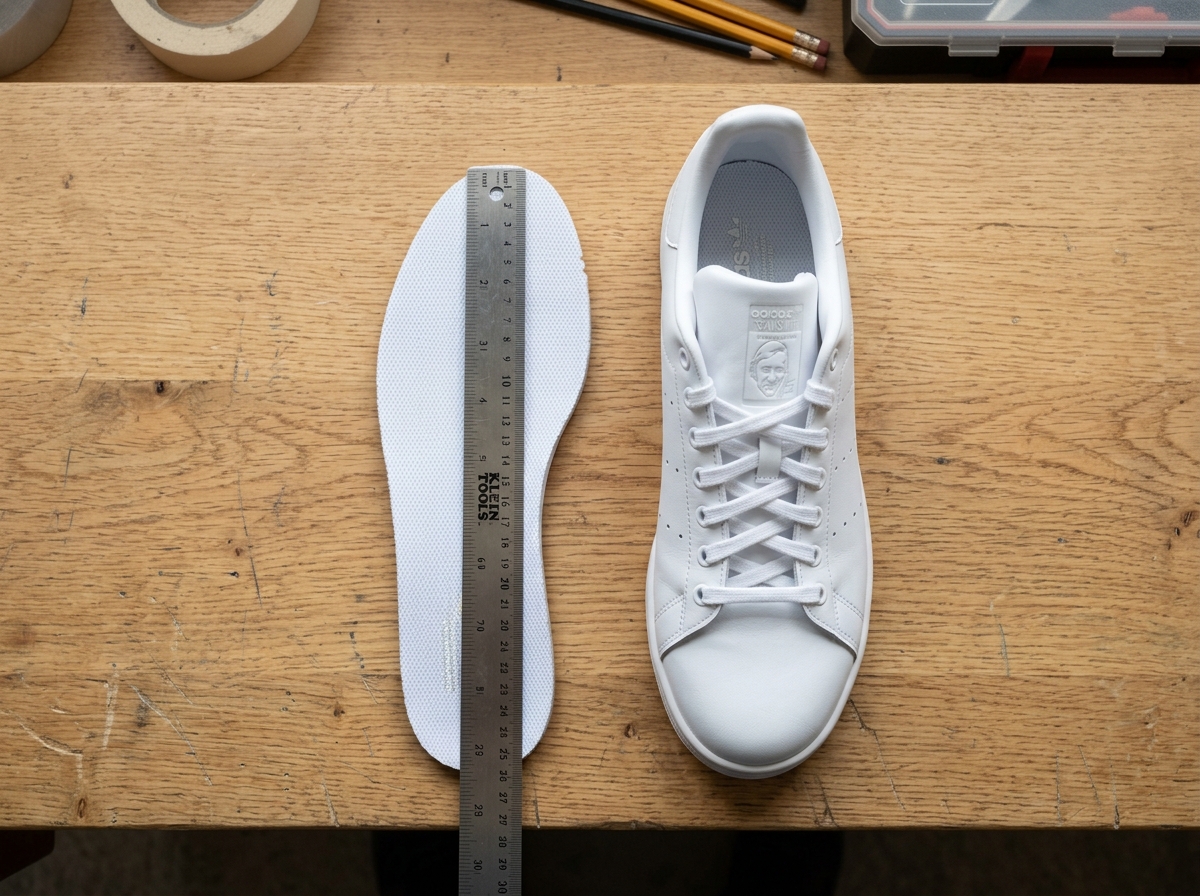
- Adidas lifestyle silhouettes provide slightly wider forefoot lasts and use fractional third EU increments such as EU 42 2/3 for US 9.
- Converse Chuck Taylor All Star canvas shoes run long, typically requiring customers to downsize by half a size.
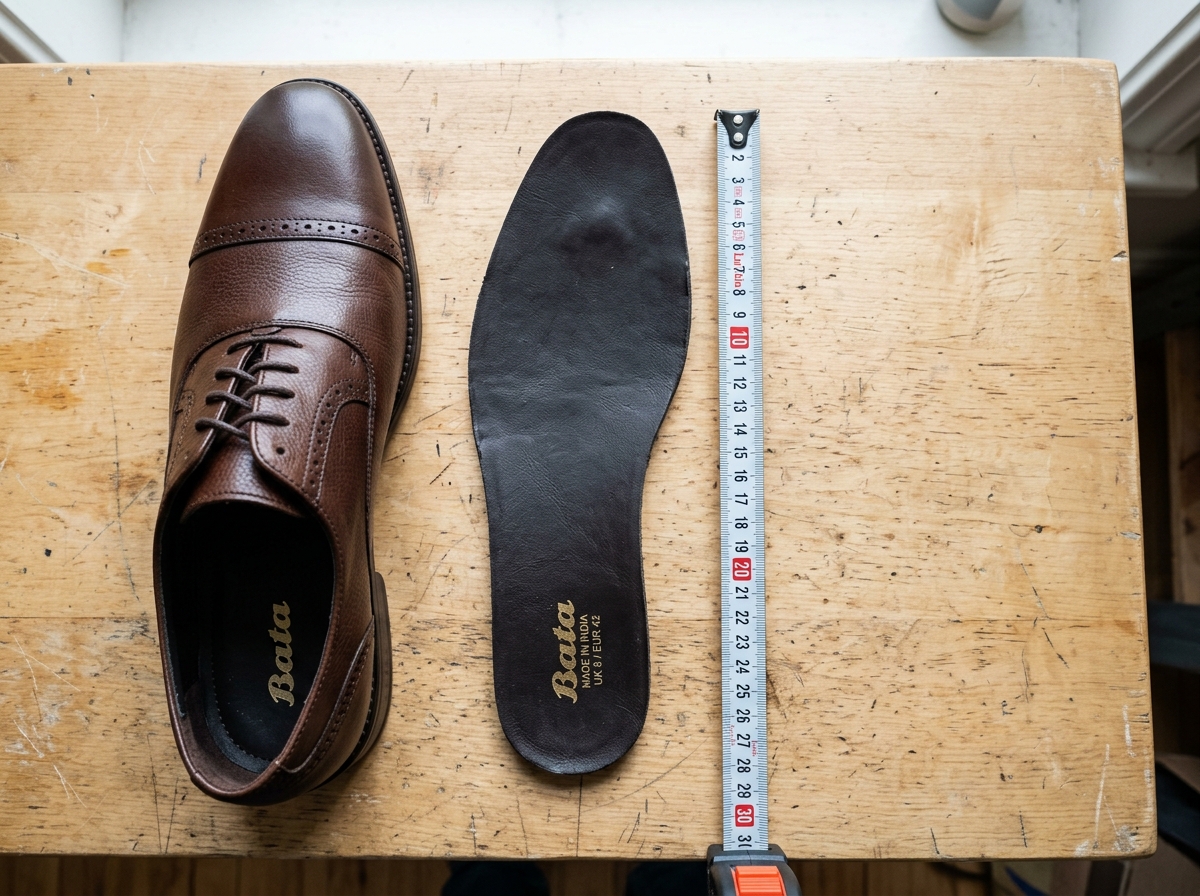
- Bata India formal dress shoes follow British IS 1638 proportions with wider ball girth clearance across the metatarsal joints.
Measuring bare feet at home
To determine your shoe size accurately, follow our documented procedure:
- Measure in the late afternoon. Feet expand slightly during the day due to walking and standing.
- Place paper against a flat wall on a hard floor. Stand upright with your heel touching the wall.
- Mark the position of your longest toe with a pencil held perpendicular to the floor.
- Measure the distance from the edge of the sheet to your pencil mark in centimeters. Size to the longer foot if your feet differ in length.
Allow 10 to 12 millimeters of toe clearance ahead of the longest toe to accommodate foot elongation during walking.